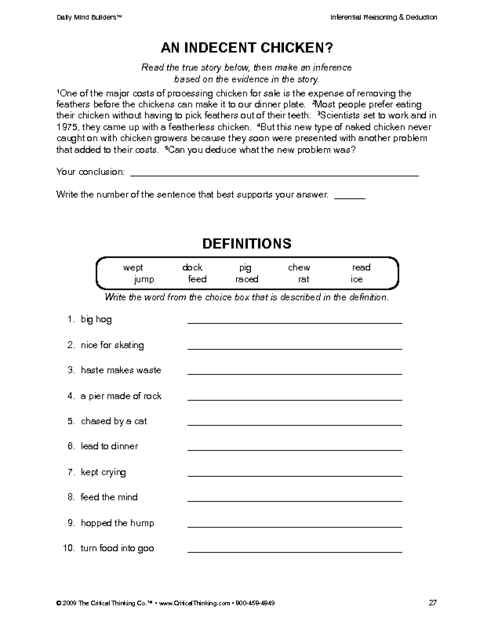
In today’s speedily changing world, the ability to think critically much more essential than actually for young students. The details age has brought in in an frustrating amount of files, opinions, and perspectives, making it imperative with regard to aspiring scholars in order to hone their important thinking skills. These types of skills not only improve academic performance, nevertheless they also put together students for actual challenges by enabling those to analyze info, evaluate arguments, plus make informed selections.
Critical thinking empowers pupils to approach troubles with an asking yourself mindset, fostering curiosity and encouraging these people to delve more deeply into subjects. It’s not just about memorizing facts; its about understanding concepts and being capable to apply understanding in practical scenarios. By developing solid critical thinking capabilities, students learn to identify between logical thinking and emotional reactions, allowing them to construct solid arguments and challenge assumptions. In this write-up, you will explore typically the essential critical considering skills every pupil needs, highlighting essential traits that define effective critical thinkers and even offering insights into how educators can easily nurture learning these skills inside the classroom.
Essential Critical Thinking Skills
Critical thinking is an essential skill set that every scholar needs to do well academically and inside life. At the core, it calls for the ability to analyze information objectively and evaluate different points of views. This process not just aids in knowing complex issues but additionally fosters the growth of strong argumentation skills. Students which think critically can easily dissect arguments, recognize biases, and detect facts from viewpoints, which are important for engaging within reasoned discussions and making informed judgements.
One other important element of critical thinking may be the potential to solve troubles effectively. Strong essential thinkers demonstrate exceptional problem-solving abilities by simply breaking down organic issues into feasible parts and methodically exploring potential remedies. They possess a natural curiosity, always asking " why" and seeking a deeper understanding of the particular subjects they analyze. This inquisitive mentality drives them in order to explore various sides and approaches, marketing a much more comprehensive mastering experience.
Furthermore, reflection in addition to self-assessment play essential roles in boosting critical thinking expertise. Students who regularly think about their thought processes and decision-making are better outfitted to recognize their strengths and weaknesses. Participating in self-assessment helps them identify areas intended for improvement and create greater independence within their thinking. By fostering these essential skills in the school room, educators can make students in order to meet the particular challenges of your quickly changing world in addition to build a strong foundation for ongoing learning.
Evaluating Critical Thinking in Students
To properly evaluate critical thinking about in students, educators can employ some sort of variety of methods that focus in observation and examination of specific abilities. One approach is definitely to create scenarios that require learners to analyze details, solve problems, and even make decisions based on evidence. Simply by presenting case scientific studies or real-world problems, teachers can determine how well learners can apply their very own reasoning skills and whether they are usually able to make coherent arguments. In addition, teachers should observe how students question presumptions and explore the particular implications of their particular conclusions.
Another useful approach involves encouraging college students to engage in conversations and debates. This specific not only can be useful for assessing their ability to articulate thoughts plainly but also shows their capacity to be able to listen critically to be able to opposing viewpoints. Assessing students' participation inside these discussions provides insight into their reasoning abilities plus how well these people can support their very own arguments with reputable evidence. Moreover, it allows educators to recognize students who exhibit both logical plus emotional reasoning, providing an holistic view with their critical thinking abilities.
Refractive practices, such because self-assessment and expert feedback, also have fun with an important role inside evaluating critical thinking. By encouraging college students to reflect in their learning operations and the performance of their problem-solving strategies, educators may help students turn into more aware of their particular thinking habits. This self-reflection not only enhances crucial thinking skills but also fosters freedom as students learn to challenge their individual assumptions and biases. like this of observation, discussion, and reflection, teachers can gain an extensive knowing of each student's critical thinking capabilities.
Acquiring and Enhancing Critical Thinking
To cultivate sturdy critical thinking abilities, students must definitely engage in conditions that promote examination and inquiry. One effective method will be to encourage asking, as critical thinkers frequently ask " why" and search for to understand the particular underlying reasons right behind various concepts. This particular process not only helps with deepening awareness and also fosters interest, prompting students to explore topics past superficial knowledge. By nurturing an inquisitive mindset, educators may help students be adept at assessing information and establishing insightful conclusions.
Another method to enhance critical thinking is throughout the incorporation of controversy and discussion in the classroom. When pupils are presented together with differing viewpoints, these people learn to articulate their very own thoughts clearly plus consider alternative viewpoints. This environment motivates the examination of logical reasoning and the identification associated with biases, strengthening students' abilities to create sound arguments and challenge assumptions. Engaging in structured arguments also sharpens problem-solving skills, enabling pupils to approach complex issues with a far more analytical lens.
Finally, reflection and self-assessment participate in crucial roles inside developing critical thinking. By regularly assessing their own reasoning processes and decision-making strategies, students can easily identify areas with regard to improvement and become more aware of their thought patterns. Stimulating reflective practices, these kinds of as journaling or peer feedback, allows students to analyze their learning experience critically. As they learn to separate facts from thoughts and recognize the significance of evidence in building conclusions, they come to be well informed and able thinkers, well-prepared to be able to tackle real-world difficulties.